
A few weeks ago, the office administrator at a services business I have been working with resigned with little notice. She ran payroll, posted the accounting entries, kept the company’s core data sets current and accurate, and handled much of the internal coordination. The data entry and system upkeep alone took more than 20 hours of her week, and for years she was the only person who knew exactly how it was done.
A year ago, her departure would have stopped parts of the business for weeks. This time it did not. Over the preceding months we had documented that work and built the connections and automations that now perform most of it. People still approve what needs approving, but the routine work runs without her. The owner expects no disruption and does not plan to fill the role.
That episode shows something the current debate about AI’s return on investment mostly misses. The value of a proper implementation shows up in the value of the business, and the largest part of it arrives long after anyone has calculated a payback period.
The question capital partners are asking
Headlines this year have questioned whether AI spending pays off, and investors are right to ask. Most of the evidence offered on either side measures the first year: hours saved, licenses bought, pilots completed. A first-year measure tells an investor little about what a business is worth, because a business is worth the present value of the free cash flow it will produce over many years, and the years that matter most come later.
Measured that way, the case for AI in a small business is a discounted cash flow argument, and it does not depend on a market survey. If a proper implementation changes the inputs to the DCF in the owner’s favor, the business is worth more. I call the difference the AI value premium.
Four ways AI changes the valuation
Done properly, an AI implementation should move each input to a discounted cash flow model.
Larger cash flows. The same team handles more work. Pricing and estimating improve as the business accumulates a record of every job, quote and customer. Overhead grows more slowly than revenue. Terminal-year EBITDA ends up higher than it would have been.
More of each dollar of EBITDA becomes free cash flow. When billing and collection run faster, less cash sits in receivables. When existing capacity absorbs growth, the business spends less on the hiring that growth would otherwise require.
Faster growth, including in the out-years. Capacity that absorbs new work without a matching increase in headcount lets the business grow faster. Growth that has been demonstrated, rather than promised, can be modeled with more confidence, so it carries more weight in the projections and in the years after them.
A lower risk premium. A business whose operating know-how is written into its systems depends less on any one person. Its processes are running every day, and its numbers are easier to verify. A buyer or lender facing less risk applies a lower discount rate.
A buyer who prices on a multiple of EBITDA reaches the same result. A multiple is a compressed DCF: it rises with growth and cash conversion and falls as risk rises. The DCF shows why it moves.
What the arithmetic looks like
Consider one business with $3.0 million of EBITDA today, valued two ways. Each case projects five years of free cash flow, adds a terminal value for the years after, and discounts both to today. The inputs below are illustrative assumptions, chosen to show the mechanics, and are not a forecast for any company.
| Assumption | Without AI | With AI |
|---|---|---|
| EBITDA growth, years 1 to 5 | 5% | 10% |
| Free cash flow as a share of EBITDA | 55% | 60% |
| Discount rate | 14% | 13% |
| Long-term growth after year 5 | 3.0% | 3.5% |
| Implementation cost | none | $0.3M in year 1, $0.2M in year 2 |
| Year 5 EBITDA | $3.8M | $4.8M |
| Value today | $16.7M | $25.0M |
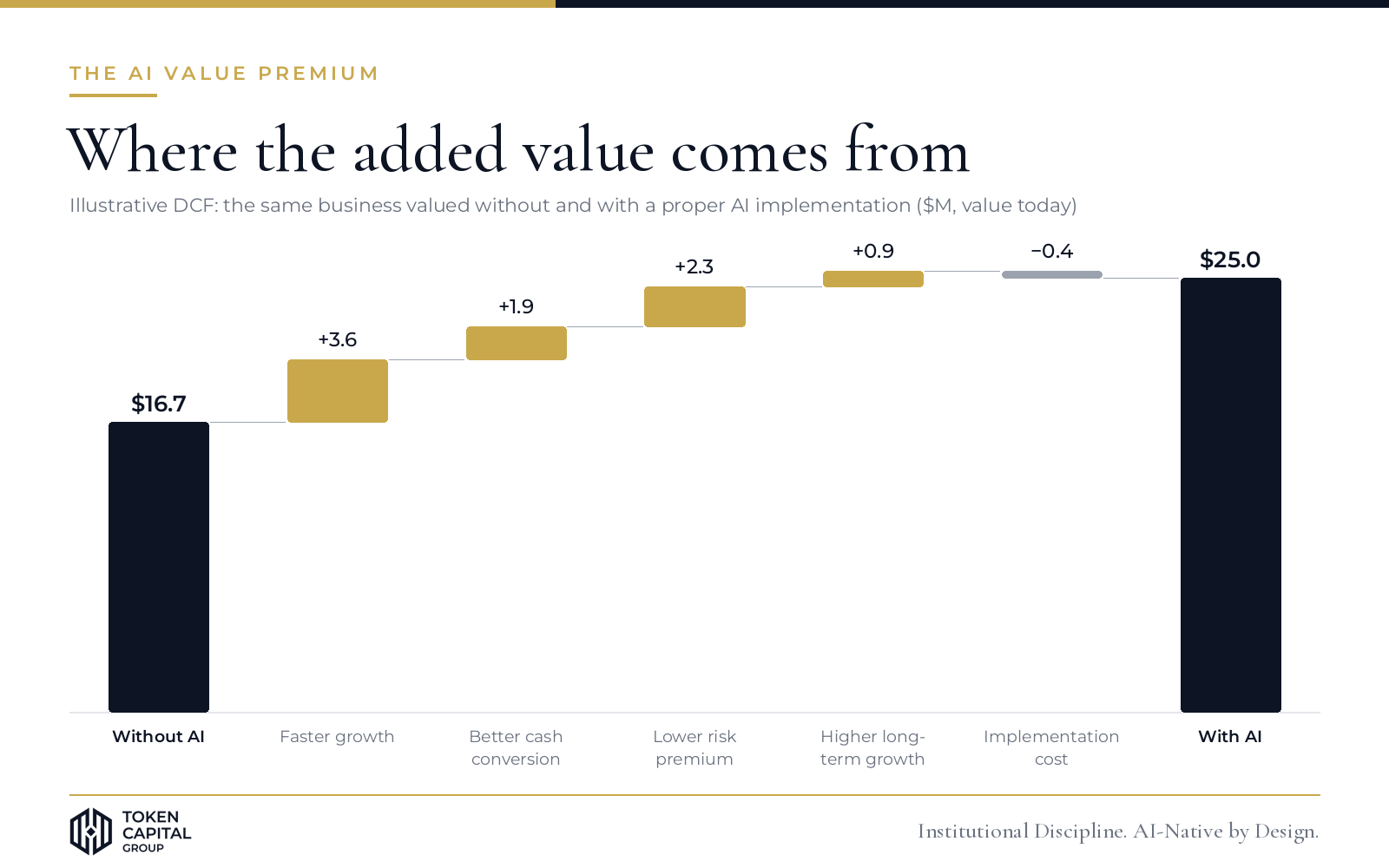
The AI case is worth $8.3 million more. Changing one input at a time, faster growth adds about $3.6 million, better cash conversion about $1.9 million, the lower discount rate about $2.3 million and the higher long-term growth rate about $0.9 million. The implementation cost subtracts about $0.4 million.
Small changes in the discount rate and the long-term growth rate move these results considerably, so the risk assumption deserves scrutiny. Leave the discount rate and long-term growth unchanged and change only growth and cash conversion, and the AI case is still worth about $5.5 million, or 33%, more. Readers should substitute their own inputs; the direction of the result holds whenever the operating effects are real.
Two features of the example matter more than the totals.
The first is how little the early cost matters. The implementation spending, and the period when productivity dips while the work is redesigned, both fall in the first two years. In present value terms they cost about $0.4 million.
The second is where the value sits. In both cases about two-thirds of the value today comes from the terminal value, the cash flows beyond year five. That is where the AI effects accumulate: the higher earnings base, the faster growth and the lower risk all carry into it. An owner judging AI by the next quarter’s results is looking at the part of the valuation that AI changes least.
An owner judging AI by the next quarter’s results is looking at the part of the valuation that AI changes least.
Durability: where small-business know-how lives
The office administrator’s departure illustrates the risk input. Every small business runs on a small core of people who know how the work gets done: how a job is scheduled, which customer needs what, how an exception is handled, where the information lives. Most of that knowledge is undocumented. When one of those people leaves, the business loses it, and the cost goes beyond recruiting. A review of 30 case studies by the Center for American Progress found the median cost of replacing an employee was 21% of annual salary, before counting the knowledge that leaves with them.
The usual remedy is written procedures, and written procedures have a known weakness: nobody tests them until someone needs them, and by then they are often out of date. An encoded workflow is different because the business runs on it every day. When it is wrong, it fails where people can see it, and someone fixes it. Documentation that the business depends on stays accurate.
There is now direct evidence that AI can capture and spread this kind of know-how. Brynjolfsson, Li and Raymond studied 5,179 customer support agents at a company that introduced an AI assistant in stages. Productivity rose 14% on average, with the largest gains among newer and less experienced agents, because the system made the practices of the most experienced agents available to everyone. Customer sentiment and employee retention also improved.
The market has also started putting a price on this knowledge. AI developers have used much of the public text available for training, and they are now paying for records of how work is done inside real companies. MIT Technology Review reported this month that SimpleClosure, which helps startups wind down, has completed more than 150 deals selling shut-down companies’ code, messages and documents to AI developers. In August, Google won a bankruptcy auction for Spirit Airlines’ internal corporate data with a $10 million bid. One data company told the Columbia Journalism Review that models are “still weak at the work behind it, the drafts, the notes, the judgment calls.” That is the knowledge a small business loses when a key employee walks out. I do not suggest owners sell it. The prices show that it is an asset, and a business that encodes its own know-how owns that asset instead of renting it from the people who hold it.
Why the returns arrive late
Economists have documented this delay before. Brynjolfsson, Rock and Syverson describe a productivity J-curve for general-purpose technologies: a business must invest in new processes and skills before the technology pays, measured productivity falls during that investment, and it rises later as the investment begins to produce output. Two decades earlier, Brynjolfsson and Hitt found that the returns from computers depended on how much firms reorganized their work around them, and that firms which added the technology to unchanged processes gained little.
My own firm shows the same pattern. Because TCG was built on an AI foundation, I can adopt new tools and features as soon as they are released and put them to work in processes that are already encoded. Each workflow I encode makes the next one faster to build. My productivity this year has compounded rather than stepped up once. And the experience of building it is what lets me advise other businesses on how to do it.
Why owners miss it
A small business owner is managing to next week’s payroll and this month’s largest sale. The AI value premium arrives over years, and it shows up in places the owner’s ROI calculation does not look: faster collections, growth that does not require new hires, and a business that no longer depends on one person. The largest part of it is realized once, when the business is sold or recapitalized, which most owners are not yet planning for, even though the business is usually most of their net worth.
What the premium requires
Not every implementation produces this result, and the skeptical case deserves a fair statement. Many AI projects show no measurable return, usually because the tools were added to work that was never redesigned or documented. At the level of the whole economy, Daron Acemoglu estimates that AI will add no more than about 0.66% to total factor productivity over ten years. That estimate is an average across all firms, including the many that will adopt little. The premium described here belongs to individual businesses that do the work.
Three conditions separate the businesses that capture it.
The work is redesigned and documented, and the documentation is put to work. Adding AI tools to existing steps saves minutes. Rebuilding the workflow around them changes the cash flows.
The know-how encoded is specific to the business. As AI developers train on real back-office work, generic tasks such as basic invoicing will increasingly work well without any effort from the owner. The lasting value is in what only this business knows: its customers, its pricing, its exceptions and its judgment calls.
The results have time to become a track record. A buyer models what a business has demonstrated. An implementation that has run for two or three years supports the higher growth rate and the lower risk premium in a buyer’s model. One completed in the months before a sale supports neither.
What a capital partner should ask
For an investor evaluating a sponsor’s AI plan, the useful questions follow from the DCF. Which workflows will be encoded, and which input does each one change: growth, cash conversion or risk? How will the business show that change in its numbers before exit? Which of the knowledge being encoded is specific to the business, and which will be available to every competitor within a few years? And how much of the operation would still stop if a particular person left?
A sponsor who answers those questions with specifics can show how the plan raises the value of the business. If the answers come back as hours saved, the plan is a cost-savings estimate, and the first-year ROI questions in the headlines apply to it.
Works Cited
- Generative AI at Work | Brynjolfsson, Li and Raymond, Quarterly Journal of Economics (2025)
- The Productivity J-Curve: How Intangibles Complement General Purpose Technologies | Brynjolfsson, Rock and Syverson, American Economic Journal: Macroeconomics (2021)
- Beyond Computation: Information Technology, Organizational Transformation and Business Performance | Brynjolfsson and Hitt, Journal of Economic Perspectives (2000)
- The Simple Macroeconomics of AI | Acemoglu, NBER Working Paper 32487 (2024)
- There Are Significant Business Costs to Replacing Employees | Boushey and Glynn, Center for American Progress (2012)
- AI labs are buying data from dead startups | MIT Technology Review (October 13, 2026)
- Google to buy Spirit Airlines business data for $10 million | Reuters (August 17, 2026)
- An AI company wanted to buy my reporting notes | Columbia Journalism Review (2026)
Related Insights: Why the Standard ROI Model Underprices AI and The Translation Gap: Why Adoption Rates Do Not Predict Value.