
For most of the history of business technology, large enterprises adopted first and smaller companies followed. Broadband, cloud computing, and enterprise software spread in that order, with capital and procurement budgets setting the pace. With AI, small and midsized businesses have nearly caught up.
The adoption gap has narrowed to about a year
A Thryv survey reported by CPA Practice Advisor found that AI use among U.S. small and midsized businesses rose from 39% in 2024 to 55% in 2025, a 41% increase in one year. CPA Practice Advisor describes the gap between small business and enterprise adoption, previously several years, as now about one year.
Why smaller companies move faster
Small businesses do not have larger budgets, deeper talent pools, or better access to the leading models. They have fewer approval layers, less legacy infrastructure to integrate, and owners who can approve an experiment directly.
At a large company, a promising use case typically passes through legal review, a security assessment, compliance approval, and budget negotiation across departments, which can take months. At an owner-led business, the same use case can be tested within a week or two. Each successful deployment makes the next one easier to approve and run, and an unsuccessful one can be stopped within days.
Where they are deploying it
The data also show a difference in where adoption starts. According to CPA Practice Advisor, large enterprises most often deploy AI for IT process automation (33%) and security or threat detection (26%), functions aimed at cost and risk. Small businesses concentrate it in customer-facing work, with marketing automation especially common.
The same revenue-side approach applies outside services. In manufacturing, the comparable uses are production scheduling and quality monitoring; in distribution, inventory planning and order routing; in transportation, route and load planning. Each lets the existing team handle more volume.
CPA Practice Advisor also reports that most AI-using small businesses saw revenue gains and that most grew their workforce over the past year, although it does not name the survey behind those two figures. If they hold up, they run against the common expectation that AI reduces headcount: small businesses that use AI well appear to be expanding what their existing teams can do, taking on more work, and hiring.
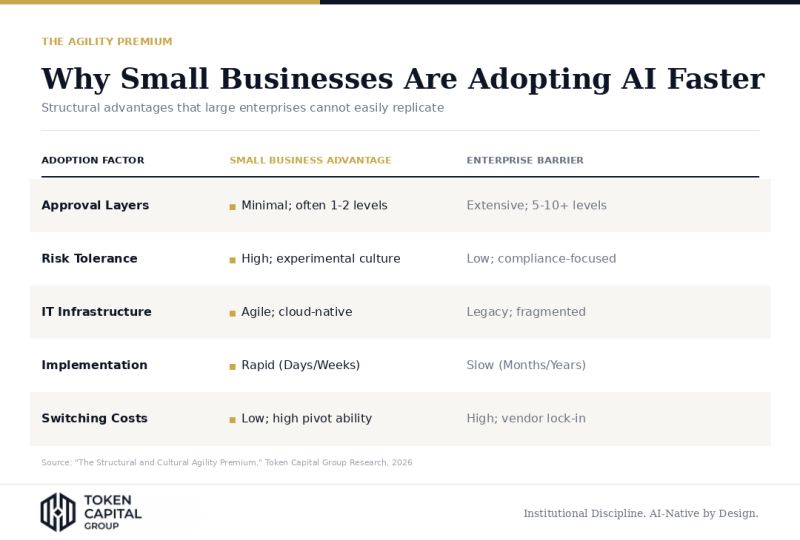
For a smaller company, the time it takes to move a use case from idea to daily operation now matters as much as the budget behind it.
What this means for the lower middle market
Lower middle market companies are large enough to have operational complexity worth automating and small enough to approve and deploy changes quickly. They avoid the approval process of an enterprise and have more resources than the smallest businesses.
For acquirers, the 55% figure settles whether AI matters in this segment. The question now is which companies have the operating discipline and the management team to deploy it quickly in the functions that produce revenue. Buyers who can identify those companies before acquiring them, and speed up deployment after closing, are positioned to capture more of the value created over the next decade.
For owners, competitors that adopt AI well can be expected to improve revenue per employee, response time to customers, and pricing accuracy. AI will change how your company operates whether or not you sell it; the decision in front of you is who will guide that change. A practical first step is to choose one revenue-side workflow, such as quoting, follow-up, or scheduling, and test AI on it this quarter.
Works Cited
- AI Momentum Belongs to Small Businesses | CPA Practice Advisor, November 6, 2025 (reporting a Thryv survey)
- Main Street Meets Machine Learning: Inside the AI Productivity Boom at Small Businesses | CPA Practice Advisor, July 17, 2025