
The payback model was built for equipment
Operators often evaluate AI with a method built for capital equipment. For a machine or an ERP system, the math is linear: model the labor savings, calculate a payback period, and depreciate the asset until the next upgrade cycle. That method works for machinery. Applied to AI, it understates the value, because the asset does not behave the way the model assumes.
A capability that improves with use
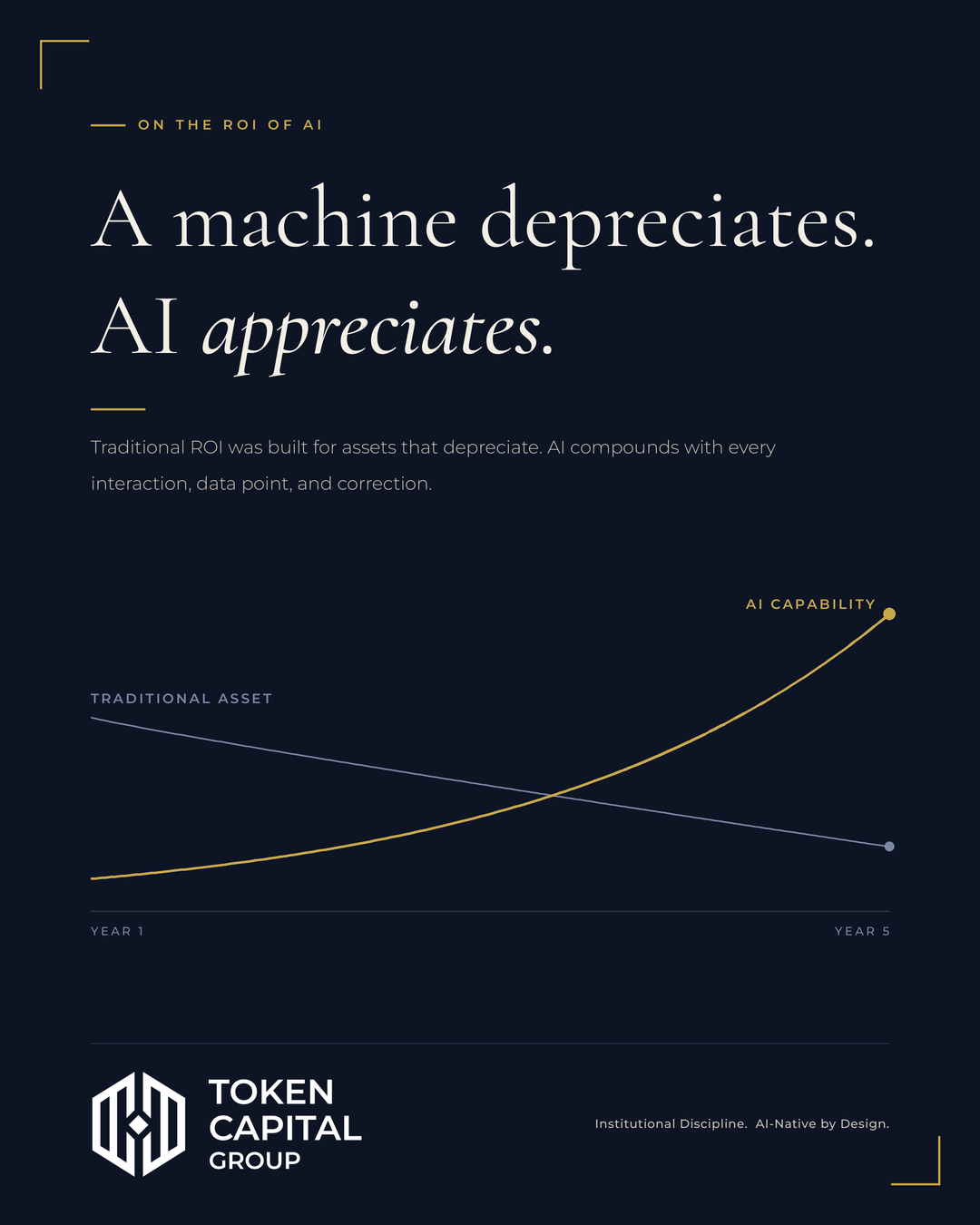
Equipment loses value as it ages, while AI applied to a specific workflow can gain value as it is used. The economist Kenneth Arrow described the underlying mechanism in 1962 as learning by doing: productivity that rises with cumulative experience.1 In an AI deployment, the experience is the business’s own record: the corrections staff make, the outcomes of past decisions, and the written standard for how the work should be done. As that record grows, the system can be retrained, re-instructed, or given better reference data, and its output improves. Because the record is specific to the business, the improvement is proprietary. A competitor can buy the same software, but it cannot buy years of your operating history.
A payback calculation run at deployment measures the tool at the lowest level of capability the business will use.
A standard ROI model assumes the tool delivered in year one provides the same utility in year three. For a deployment that is maintained and supplied with the business’s data, that assumption understates year three. A predictive maintenance model may produce a modest gain in its first month and a larger one in each month after, as it accumulates sensor readings and failure history. A pricing model that quotes freight lanes or distribution orders can start adequate and improve each quarter as it records which bids won and which margins held. The later years are worth more than the early ones, the reverse of a depreciating asset, and a payback period does not measure that.
Cost reduction versus added capability
The second error is more expensive than the first. Using AI mainly to cut costs produces a temporary increase in earnings, and competition tends to remove it. Any saving a business can buy, its competitors can buy as well, and over time those savings pass to customers through lower prices. Durable value comes from what is harder to copy: increasing what the existing team can produce, reaching revenue the business could not serve before, and building operating leverage that grows with the business’s own data. That advantage lasts because it depends on proprietary operating history rather than on the purchase.
What a static model leads to
A business that judges AI only on a payback period makes both errors at once. It prices the asset as if it depreciates, and it aims the asset at the outcome competitors will erase. The likely result is underinvestment in the capability that improves over time, decided by a team that believes it is being disciplined.
We underwrite AI differently. At Token Capital Group, the improving capability is part of the investment thesis rather than a line in the cost model. We look for businesses with enduring demand, where the physical world requires physical products, physical movement, and physical work, and we treat intelligent automation as an asset that becomes more valuable the longer we operate the business. In practice, that means budgeting from the start for the documentation, data, and review work that makes the improvement possible, and holding the business long enough to realize it.