
Earlier this year, the Budget Lab at Yale published its January and February CPS update1, and the headline finding deserves more attention than it has received. Aggregate U.S. employment data does not yet show a statistically significant AI effect. Occupational dissimilarity, industry dissimilarity, and the standard labor market exposure metrics all remain flat, within historical ranges, or continuing along trends that predate the current generative AI cycle. The researchers, and the Fortune coverage of the release, coined a term for the gap between the prevailing narrative and what the labor market data actually shows. They call it AI-washing.
The accusation is specific. Companies are citing AI to justify layoffs, hiring freezes, and slower onboarding that the macro data cannot yet corroborate. Some of the reasoning is genuine. Some is convenient. The Yale researchers are not arguing that AI will leave employment untouched. They are arguing that, as of the most recent Current Population Survey, the aggregate picture remains quiet.
That is one half of the picture. The other half is less comfortable.
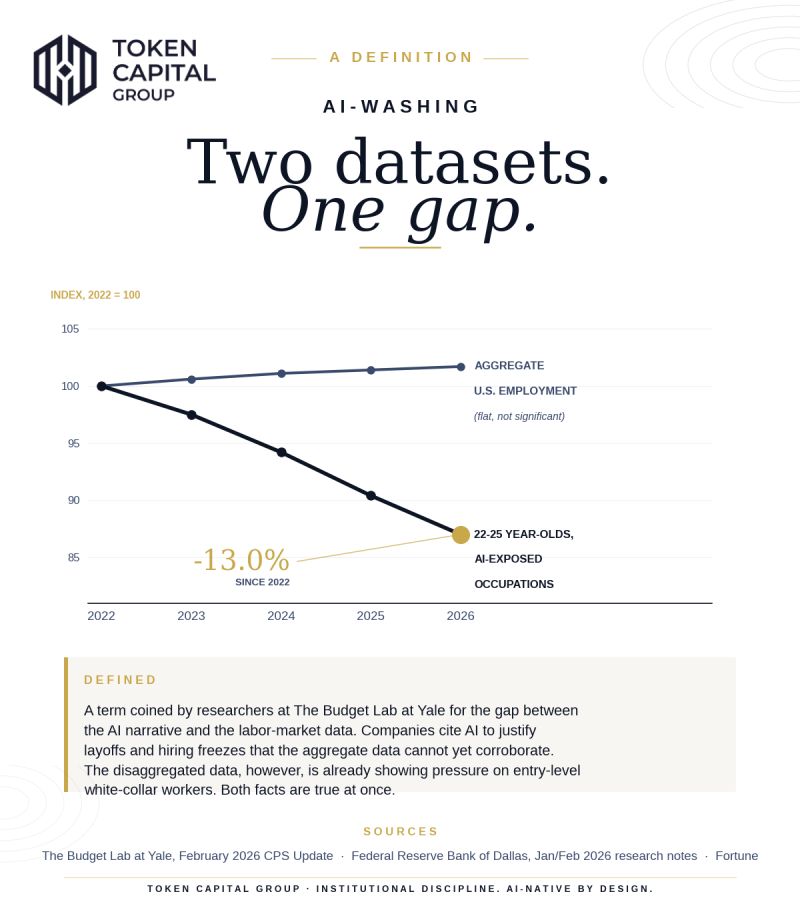
The disaggregated picture is not quiet.
In a January 2026 research note, the Federal Reserve Bank of Dallas surfaced findings from a Stanford University study that have not received the airtime the aggregate Yale work has. Among workers aged 22 to 25 in the most AI-exposed occupations, employment has declined 13% since 2022. The drop is not driven by layoffs alone. It is driven primarily by a decline in transitions from outside the workforce into employment, which is to say, the entry-level on-ramp has narrowed.
The Dallas Fed followed up with a February 2026 note framing the same dynamic in wage data. Their title is direct: AI is simultaneously aiding and replacing workers. Wages show the technology operating as both an augmenter and a substitute, depending on where workers sit in the experience curve. The same tools that augment a senior practitioner can foreclose the apprenticeship paths that produced senior practitioners in the first place.
Read alongside each other, the two halves do not contradict. They describe a labor market in which the aggregate is unmoved while a specific cohort, entry-level white collar workers in AI-exposed roles, is genuinely under pressure. The macro data has not caught up because that cohort is small relative to the whole. The disaggregated data is doing the work of an early warning.
Both things are true at once. The aggregate picture is quiet. The disaggregated picture is not.
What this means for lower middle market acquirers.
For founder-operators thinking about a sale in the next 12 to 36 months, this gap is worth watching for two reasons.
First, the public narrative about AI and employment is going to shift faster than the aggregate data, and it will create real pressure on workforce planning at companies whose operating model depends on stable hiring. If the public conversation moves to “AI-washing has been a cover for real displacement” before the macro data catches up, hiring decisions, customer expectations, and the cost of recruiting will move with the narrative, not with the data.
Second, not every AI-attributed layoff is caused by AI, and not every workforce will be spared. A buyer’s posture toward this gap matters. An acquirer who treats AI as a justification for headcount reductions on Day One is not the same as an acquirer who treats AI as a capacity multiplier that lets the existing team take on more valuable work. Sellers should ask which posture they are signing up for. So should the capital partners funding the deal.
The discipline of sitting with both halves.
Honest stewardship is not reassurance that nothing will change. It is the discipline to sit with both halves of the evidence and to conduct the work with respect, dignity, and transparency through a transition no acquirer fully controls.
Token Capital Group acquires businesses with enduring demand and deploys intelligent automation to compound their value. That mandate produces real change in how work gets done. We do not pretend otherwise. The commitment we make to management teams and to the people who built the businesses we acquire is not that no role will ever be reshaped. It is that every person will be treated as a human being throughout the process, and that the rationale for any change will be specific, sourced, and defensible. The data does not yet license a comfortable story in either direction. The honest reading is that both halves are true. The work is to act accordingly.
Works Cited
- Evaluating the Impact of AI on the Labor Market: January/February CPS Update | The Budget Lab at Yale
- If AI is roiling the job market, the data isn’t showing it, Yale Budget Lab report says, raising questions of ‘AI-washing’ to justify mass layoffs | Fortune
- Young workers’ employment drops in occupations with high AI exposure | Federal Reserve Bank of Dallas
- AI is simultaneously aiding and replacing workers, wage data suggest | Federal Reserve Bank of Dallas