
The integration of artificial intelligence into the global economy has definitively moved beyond speculative enthusiasm and entered a period of rigorous, compounding structural stratification. Between 2024 and 2026, the rapid proliferation of large language models, multimodal architectures, and autonomous agentic systems initiated a profound divergence in economic performance, operational efficiency, and capital accumulation. This divergence is not a matter of adoption speed; it is a fundamental shift in organizational DNA, individual cognitive workflows, and regional macroeconomic infrastructure.1
Unlike previous cycles of general-purpose technologies, where initial adoption gaps compressed relatively quickly as tools commoditized, the current AI deployment cycle exhibits a distinct, compounding network effect. The mechanisms driving the divergence are rooted in tacit-knowledge externalization, proprietary data moats, and continuous learning feedback loops. They structurally favor early adopters and AI-Native organizations, suggesting that the gap between leaders and laggards is accelerating rather than closing.
AI capabilities exhibit compounding returns to scale, data aggregation, and workflow redesign. The divide is widening, not narrowing, and the gap appears increasingly insurmountable.
Operating thesis
Defining the AI maturity spectrum.
To analyze the structural dynamics of the 2026 AI economy systematically, it is necessary to establish a clear taxonomy of AI adoption and integration. The maturity spectrum we use is categorized into four tiers, AI-Unaware, AI-Curious, AI-Enabled, and AI-Native, each with distinct observable markers, capability differentials, and cultural signals across three units of analysis: individuals, organizations, and national or regional economies.2
| Tier | Posture | Operating reality | Data & architecture |
|---|---|---|---|
| AI-Unaware | Existing paradigms preserved | Manual processes; no AI usage | No proprietary data infrastructure |
| AI-Curious | High enthusiasm; uncoordinated | Ad hoc generative tool use | Personal productivity, no org integration |
| AI-Enabled | AI bolted onto existing workflows | Structured use across select functions | Custom automation; some measurable lift |
| AI-Native | AI as foundational infrastructure | Every function built around AI | Compounding data and workflow advantage |
Granular definitions and observable markers.
AI-Unaware entities operate under the assumption that existing technological and operational paradigms will remain defensible indefinitely. For organizations, particularly in the lower middle market and SMB sectors, this tier is marked by fully manual operations, fragmented and unstructured databases, and human-dependent scaling constraints. The defining cultural signal is a combination of skepticism and defensive posturing, AI is viewed as overhyped novelty, or as an immediate existential threat to job security.
AI-Curious actors are characterized by high enthusiasm but uncoordinated, unstructured experimentation. Individuals interact with generative models in what we call a One Player Game: inputs and outputs are ephemeral, a thousand employees might interact with an LLM a thousand different times, but because the interactions are isolated, no shared organizational memory forms and institutional capability fails to compound. Friction between grassroots enthusiasts and skeptical executive management is highest in this tier; abandonment rates are correspondingly high.
AI-Enabled entities recognize AI’s utility but treat it fundamentally as a downstream optimization mechanism. Organizations deliberately bolt AI on top of existing architectures to achieve localized micro-productivity gains, call summarization, ticket routing, document processing. The strategic intent remains conservative: do the same things, faster and cheaper, rather than redefine the nature of the work. Infrastructure relies heavily on third-party APIs and vendor updates, often lacking closed-loop feedback mechanisms.
AI-Native actors view AI not as a tool to be utilized, but as infrastructure to be inhabited. The AI architecture is the business strategy. Workflows are redesigned from first principles to leverage autonomous agents that handle entire operational sequences. Data is structured for machine-learning ingestion, using deep semantic ontologies that preserve context rather than forcing models to parse rigid relational schemas. Culturally, AI-Native environments normalize rapid iteration and the generation of imperfect AI-drafted starting points. For the individual knowledge worker, the AI-Native state is one of superagency, the human acts as orchestrator and strategic editor of machine output.
Current state of the divide, 2024 to 2026.
The empirical data emerging from 2024 through Q1 2026 illustrates a macroeconomic landscape defined by rapid, yet highly uneven, acceleration. Topline adoption has surged dramatically; translation of that usage into measurable enterprise-level profitability and sustained productivity remains highly concentrated at the very top of the maturity spectrum.
The surge in baseline adoption and investment.
According to the Stanford HAI 2025 AI Index, broad organizational usage of artificial intelligence jumped from 55% in 2023 to 78% in 2024. The deployment of generative AI in at least one core business function more than doubled in that timeframe, from 33% to 71%. This adoption is fueled by a staggering disparity in global private investment: in 2024, the United States led with $109.1B, nearly 12× the $9.3B invested by China and 24× the $4.5B invested by the United Kingdom. Hardware costs declined 30% annually, and inference costs for systems performing at the level of early LLMs dropped over 280-fold between late 2022 and late 2024.3
By 2026, longitudinal analyses from the U.S. Census Bureau and the BTOS revealed that the adoption gap between large enterprise corporations and smaller entities was shrinking faster than historical technological precedents would suggest. While early 2024 saw large businesses using AI at nearly twice the rate of small businesses (11.1% vs. 6.3%), by late 2025 and early 2026, small business adoption had reached 8.8% under strict definitions, and up to 17.3% when measuring any functional business use. Vendor data and chamber of commerce surveys in 2026 indicate 68% of small businesses report regular AI usage, with 96% of SMB owners signaling explicit intent to adopt.
Organizational output gaps and the value hump.
Despite widespread baseline adoption, deep structural maturity remains exceptionally rare. McKinsey’s 2025 research found that while 92% of companies plan to increase their AI investments over the next three years, a mere 1% of executive leaders consider their organizations highly mature on the deployment spectrum, meaning AI is fully integrated into end-to-end workflows and driving substantial, measurable business outcomes. McKinsey estimates a long-term AI opportunity of $4.4T in added productivity from corporate use cases, yet notes a severe disconnect between current spending and actual value realization.
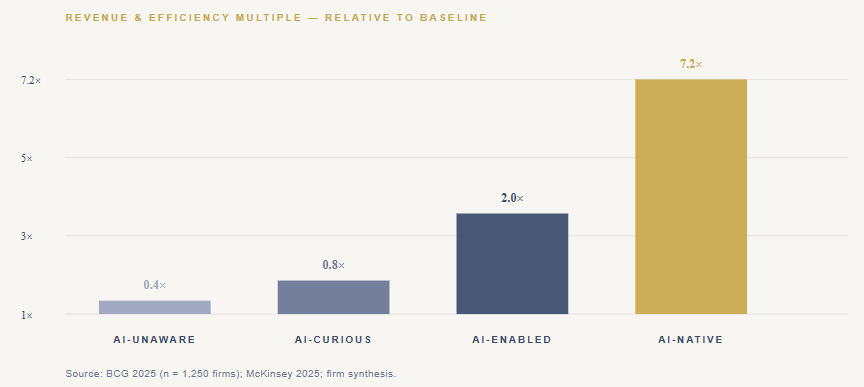
BCG’s 2025 evaluation of more than 1,250 firms worldwide found that only 5% of companies are achieving AI value at scale. These top performers, designated future-built or AI-Native firms, have put in place the critical capabilities required to make AI work at the level of systemic innovation. In contrast, a full 60% of companies report minimal revenue or cost gains despite substantial capital investment, remaining trapped in low-yield pilot phases. The empirical difference is massive: the most AI-fit companies deliver AI-driven revenues and operational efficiencies 7.2× higher than their lagging peers.
Individual learning curves.
At the microeconomic level, the divide is equally pronounced. The Anthropic Economic Index, tracking millions of real-world interactions through early 2026, reveals significant capability differentials based on user tenure, education, and strategic intent. Novice users primarily use AI for simple automation, deploying the technology for lower-wage tasks and directive commands. Experienced users, by contrast, employ AI for high-complexity, high-wage work, sophisticated software architecture, advanced data analysis, scientific research, and engage heavily in collaborative interaction, where the user iteratively guides the model to complement domain expertise.
Crucially, this experience compounds quantitatively. High-tenure users demonstrate a 10% higher success rate in eliciting accurate responses. Even when controlling for task selection, country, and language, experienced users maintain a 3-to-4 percentage-point higher success rate on the same tasks. They also exhibit refined intelligence calibration, selectively using the most powerful, expensive models for high-wage complex tasks while defaulting to faster, cheaper models for routine operations. Human capital, judgment, and prompt engineering compound the underlying technological advantage.4
Mechanisms driving divergence.
The central thesis is that AI capabilities exhibit compounding returns to scale, data aggregation, and workflow redesign. Rather than compressing naturally over time through market equilibrium, the gap between AI-Native and AI-Unaware is structurally engineered to accelerate due to several interacting mechanisms.
Pilot purgatory and the instability of the AI-Curious tier.
The AI-Curious tier is fundamentally unstable; it is a transitional state in which entities either regress to AI-Unaware out of frustration, or break through to AI-Enabled. The widespread phenomenon of pilot purgatory is the primary evidence. MIT research published in 2025 demonstrated that 95% of enterprise generative AI pilot projects fail to deliver measurable business impact and consequently fail to scale beyond the experimental phase.5
This systemic failure rate is driven by the mismatch between highly capable generative models and the poor underlying data infrastructure of typical organizations. Curious-tier organizations frequently apply advanced LLMs to disconnected, unstructured data silos without a clear definition of the business problem they are attempting to solve. Workers find themselves acting as Human Middleware: expending immense cognitive effort to compress organizational context into prompts, then re-injecting nuance, judgment, and formatting into generic output.
The new economic moat is no longer the foundational model’s weights, but the proprietary enterprise data used for continuous fine-tuning.
On the Free Lunch Dilemma
The training data paradox and tacit-knowledge accumulation.
AI-Native organizations pull away from competitors because they solve what we term the Training Data Paradox. Off-the-shelf, open-source LLMs represent an unprecedented compression of human knowledge, but they are trained almost exclusively on explicit, codified information. They miss the undocumented reasoning patterns, informal heuristics, situational awareness, and context-dependent judgment that human experts develop over years of specialized experience. This is what philosopher Michael Polanyi termed knowledge we cannot tell, and it remains structurally inaccessible to standard transformer architectures trained on static text corpora.
AI-Native firms capture this tacit knowledge by deploying continuous learning loops, telemetry tracking, and semantic data ontologies tailored to their operations. The proprietary models that result understand why certain decisions are made by top human performers, rather than just identifying statistical patterns. In compliance, an AI-Enabled tool flags that “access controls” and “authentication policies” appear in the same documents; an AI-Native system, using a business-specific ontology, understands that access controls are the security measures implemented through authentication policies to meet specific regulatory requirements based on data sensitivity. As proprietary systems process more internal operational data, they become exponentially more accurate, a self-reinforcing data network effect and a highly defensible data moat.
Architectural intent: bolting on vs. rebuilding.
The traditional AI-Enabled company operates under the paradigm that humans do the primary work, and AI serves as a fast assistant to speed up components of that work. An AI-Native company uses autonomous agents to run entire end-to-end workflows, with humans transitioning to roles focused on orchestrating, evaluating, and innovating the overarching system. Because AI-Native platforms are built with model-driven logic and adaptive infrastructure designed for continuous inference, they operate under fundamentally different economic rules, capable of scaling revenue and operational throughput without the linear requirement of scaling headcount.
Economic and competitive consequences.
Labor markets and adaptive capacity.
AI is driving a pronounced, skill-biased technological change. As of early 2026, workers possessing advanced AI skills command a 56% wage premium over non-skilled counterparts. Exposure is highly uneven: occupations most exposed to automation and augmentation include computer programmers (~75% task coverage), customer service representatives, data entry keyers, and financial analysts. Conversely, physical and in-person roles experience virtually zero AI exposure.
Catastrophic mass unemployment has not materialized, and the unemployment gap between most- and least-AI-exposed workers remains small. But there are concerning shifts in hiring: a 14% drop in the job-finding rate for workers aged 22–25 attempting to enter highly exposed white-collar professions. If autonomous agents perform the routine, foundational tasks traditionally assigned to junior employees, the apprenticeship model of human capital accumulation breaks down. For professionals with high adaptive capacity, the transition to AI-Native orchestration acts as a multiplier; for those without, it acts as a compression.
Firm-level valuations and M&A.
Capital markets are aggressively pricing in the AI maturity divide. Global M&A deal values surged in 2025 and early 2026, finishing 2025 up 43% to $4.7T, driven by megadeals, infrastructure investments, and technology convergence. The strategic nature of these acquisitions has shifted: traditional buyouts have taken a back seat to hybrid transactions designed to secure AI talent and compute infrastructure, part acquihire, part infrastructure financing, part strategic partnership. AI maturity is becoming a non-negotiable due-diligence metric. AI-exposed industries that successfully integrated the technology posted 27% higher revenue per employee between 2018 and 2024.
The commoditization counterargument.
A prevailing counterargument asserts that AI capabilities will inevitably commoditize, compressing the gap between leaders and laggards. Open-source models, Llama, Mistral, DeepSeek, now rival proprietary closed-source models on benchmarks, effectively driving the base cost of digital intelligence toward zero. Empirical evidence from 2026 severely complicates this thesis. While the generic reasoning engine has indeed commoditized, the application, infrastructure, and governance layers have not. Executive leadership faces what Berkeley researchers have called the Free Lunch Dilemma: open-source models only deliver enterprise value if a company possesses the engineering infrastructure to deploy, govern, and customize them at scale. Commoditization lowers the barrier to entry, enabling the jump from AI-Unaware to AI-Curious, but does not automatically bridge the chasm to true AI-Native status.
Geographic concentration and the Star Hub phenomenon.
AI capability is exhibiting extreme geographic clustering, exacerbating long-standing regional inequalities. Brookings research from 2025 and 2026 reveals a winner-take-most dynamic in the United States, where a short list of 30 Star Hub metropolitan areas accounts for two-thirds of all AI-related job postings.6
North Carolina is a microcosm of this divide. Charlotte and the Research Triangle have positioned themselves as AI-Native ecosystems through the Charlotte AI Institute for Research, massive data center build-outs, and dedicated AI undergraduate degrees, creating self-reinforcing hubs of talent density. Rural regions within the same state, lacking digital talent pools, broadband, and capital access, face a rapidly expanding readiness gap. Because talent and ecosystems compound synergistically, regions that lag in initial adoption are predicted to suffer unrealized opportunities that may persist for up to 50 years, making catch-up nearly impossible without external intervention.
Globally, Microsoft’s 2025 AI Diffusion Report documents a widening divide between Global North and Global South: 24.7% of the working-age population in the North actively uses generative AI, vs. 14.1% in the South, and the growth rate in the North vastly outpaces the South.
Political backlash and regulatory retrenchment.
By 2025 and early 2026, generalized societal anxiety materialized into measurable political backlash. U.S. polling showed tech and AI companies’ net favorability dropping below that of Immigration and Customs Enforcement, an unprecedented signal that AI has transitioned in public consciousness from aspirational technology to immediate socioeconomic threat. Concurrently, governments scaled back comprehensive AI safety frameworks to court investment and maintain technological sovereignty.
United States. On day one of his 2025 term, President Trump revoked the Biden-era Executive Order 14110, implementing an “innovation-first” mandate. Colorado’s landmark comprehensive AI law faced immediate pushback, resulting in a 2026 repeal-and-replace that abandoned strict EU-style impact assessments in favor of a weaker privacy-style notice regime.
European Union. Under pressure from domestic industry, the EU delayed enforcement of critical high-risk provisions of the AI Act via a Digital Omnibus until 2027/2028, and withdrew the proposed AI Liability Directive entirely.
Canada & the UK. Canada’s Bill C-27 collapsed amid political turbulence, leaving the country without a binding federal framework. The UK explicitly chose a lighter-touch, non-statutory approach to compete for AI capital.
This fractured deregulatory rulebook heavily favors AI-Native tech giants with the capital to navigate complex compliance landscapes, while leaving smaller, AI-Curious firms exposed to fragmented liabilities.
Trajectory: historical precedents and future scenarios.
Historical precedents are instructive. During the Second Industrial Revolution, factories initially adopted electric motors by simply swapping a centralized steam engine for a centralized electric motor, retaining the same shaft-and-belt architecture. Productivity gains were negligible. Only when visionaries like Henry Ford redesigned the factory floor around the distributed capabilities of independent electric motors, the AI-Native equivalent, did production explode and prices collapse. Rural electrification and broadband show that geographic infrastructure divides can persist for decades. AI, however, is moving at a drastically accelerated pace; Anthropic researchers estimate AI diffusion is occurring up to 10× faster than prior consequential technologies of the 20th century.
Scenario 1: Structural Cleavage.
Compounding returns of proprietary data, tacit-knowledge extraction, and autonomous agentic workflows create insurmountable economic moats. Over the next decade, the top 5% of AI-Native firms achieve hyper-scale efficiency, capturing monopolistic share in professional services, logistics, healthcare, and software. AI-Unaware and perpetually AI-Curious organizations are driven from the market by margin collapse and the inability to match the pricing power of autonomous systems. The labor market bifurcates severely; the cognitive middle class is hollowed out; political instability follows.
Scenario 2: Managed Convergence.
Open-source democratizes not only models but the agentic infrastructure required to deploy them. Drag-and-drop AI workflow builders become ubiquitous and cheap. Federal and regional interventions, akin to the Connect America Fund for broadband, subsidize upskilling, open data trusts, and compute access for underserved regions, flattening the Star Hub advantage. The economy transitions smoothly into a higher productivity equilibrium.
Current empirical data heavily suggests a trajectory leaning toward Scenario 1, with elements of Scenario 2 acting as a mitigating floor. Generic generative tools will commoditize, allowing AI-Unaware to jump to AI-Enabled relatively easily, but the leap to true AI-Native will remain tightly gated by an organization’s ability to digitize uncodifiable tacit knowledge and reform its operational culture.
Strategic implications.
For individual professionals.
Knowledge workers must transition immediately from viewing AI as an advanced search engine to using it as a collaborative, agentic reasoning engine. Three imperatives:
- Escape the One Player Game. Move beyond ad hoc, reactive prompting. Build personal libraries of custom GPTs, agentic workflows, and system prompts that autonomously handle routine, repetitive tasks.
- Cultivate and leverage tacit knowledge. As routine cognitive tasks are automated, human economic value will concentrate in areas AI architectures struggle to parse, complex multiparty negotiation, physical-world context, strategic ambiguity, empathy, ethical judgment.
- Master AI orchestration. Career positioning over the next five years relies on the ability to manage, evaluate, and direct arrays of autonomous agents. The successful professional will function as executive editor and strategist, rather than ground-level producer.
For SMB owners and operators.
The 2026 BTOS and vendor data clearly indicate that the initial technological adoption gap between large enterprises and SMBs has effectively closed. The remaining barrier to parity is rigorous operational execution.
- Overcome pilot purgatory. Do not boil the ocean. The most successful transitions occur when a business identifies a single high-friction operational bottleneck, inquiry routing, contract summarization, and integrates a robust AI solution deeply into that specific workflow before expanding laterally.
- Prioritize deep data infrastructure. Generative AI is operationally useless, or actively harmful via hallucinations and breaches, without clean, governed data. Transition aggressively from siloed legacy spreadsheets and fragmented software into unified, machine-readable cloud environments.
- Synthesize speed and soul. SMBs cannot out-compute or out-spend tech giants. The strategic imperative is to use AI to ruthlessly automate back-office drudgery, then reinvest the reclaimed time into hyper-personalized human relationships with clients, blending AI efficiency with irreplaceable human empathy.
For capital allocators and investors.
- Differentiate AI-Bolted from AI-Built. Due diligence must probe underlying digital architecture. Does the firm rely on manual updates to third-party APIs (AI-Enabled), or does it possess a continuous CI/CD pipeline that autonomously retrains models on proprietary, tacit operational data (AI-Native)?
- Assign a premium to the data moat. With the rapid commoditization of base LLM reasoning, premiums should be assigned to legacy companies holding exclusive, high-value, unstructured datasets, specialized industrial schematics, decades of proprietary medical outcomes, nuanced legal archives. These can fine-tune open-source models into highly defensible, bespoke industry leaders.
- Monitor the shifting M&A landscape. Strategic opportunities will lie in hybrid M&A, where well-capitalized legacy companies acquire smaller AI-Native startups not for current revenue, but to inject AI-Native DNA, infrastructure, and top-tier talent into stagnant operating models.
Conclusion.
The structural divide between AI-Unaware and AI-Native actors is not a temporary phase of technology adoption. It represents the formation of a fundamentally new macroeconomic reality. The organizations, regions, and individuals that recognize artificial intelligence not merely as a software tool to be utilized, but as a comprehensive infrastructure to be inhabited and mastered, will dictate the competitive landscape of the coming decade.
Works Cited
- AI in the workplace: A report for 2025 | McKinsey
- What Is the AI Backlash? Why Public Sentiment Toward AI Is Worse Than ICE | MindStudio
- What AI Maturity Looks Like in the Enterprise in 2026 – Parloa
- AI-Native vs AI-Enabled Companies | Shieldbase
- The AI Maturity Matrix – Boston Consulting Group
- Global AI Adoption in 2025 – AI Economy Institute | Microsoft
- Best AI tools for small businesses in 2026 | Gladly
- AI for Small Business 2026: Tools, ROI & How to Start (Complete Guide)
- 95% of AI pilots flop, General Assembly has a solution – Axios
- Why 95% of Generative AI Pilots Are Failing, And How Data-Quality Is the Missing Link
- AI-Native vs. AI-Enabled: What is the Difference
- AI-enabled vs. AI-native platforms: The key differences – Star | Global
- The Regulatory Tide Goes Out: What Global AI Governance Retrenchment Means for Organizations
- AI-Native Organizations: Resetting The Business Dynamic – Forbes
- Tacit Knowledge Is Your Next Competitive Moat – California Management Review
- Executive Order No. 24: Advancing Trustworthy Artificial Intelligence That Benefits All North Carolinians | NC Governor
- AI seems everywhere, but regional readiness is uneven – Brookings Institution
- The Structural Dynamics of AI Adoption | Foster-Fletcher
- The Impact of Artificial Intelligence Adoption on Organizational Decision-Making: An Empirical Study Based on the Technology Acceptance Model in Business Management – MDPI
- Exploring Facilitators and Barriers to Managers’ Adoption of AI-Based Systems in Decision Making: A Systematic Review – MDPI
- Why Most AI Initiatives Stall, and How to Escape Pilot Purgatory – UnBPO
- Want More Out of Your AI Investments? Think People First | Bain & Company
- AI-native vs. AI-powered: Why architecture matters in the age of intelligence – Strike Graph
- How AI Culture is Defined by the Worst Behaviors You Tolerate
- The Uncodifiable Advantage: Tacit Knowledge as the Strategic Bottleneck in AI Systems | by Shashwata Bhattacharjee | Medium
- The 2025 AI Index Report | Stanford HAI
- Economy | The 2025 AI Index Report | Stanford HAI
- Small Business AI Adoption Statistics for 2025: A Comprehensive Analysis
- How Many Businesses Are Using AI? – Economic Innovation Group
- Research Spotlight – AI In Business: Small Firms Closing In – SBA Office of Advocacy
- The Widening AI Value Gap – Boston Consulting Group
- Want ROI from AI? Go for growth – PwC
- Anthropic Economic Index report: Learning curves
- The Anthropic Economic Index report: New building blocks for understanding AI use
- Anthropic Economic Index report: Uneven geographic and enterprise AI adoption
- (PDF) The technology acceptance model and adopter type analysis in the context of artificial intelligence – ResearchGate
- The technology acceptance model and adopter type analysis in the context of artificial intelligence – PMC
- Artificial intelligence and knowledge management: questioning the tacit dimension – ScienceOpen
- The Free Lunch Dilemma: How Companies Are Converting Open-Source AI into Profitable Business Models
- Labor Protests Rise Amid AI Job Security Fears – AI CERTs News
- How AI and Other Technology Impacted Businesses and Workers – Census Bureau
- Will the use of artificial intelligence lead to a decline in the accumulation of human capital or to an acceleration of its growth, and why? | ResearchGate
- Measuring US workers’ capacity to adapt to AI-driven job displacement – Brookings Institution
- AI’s increasing impact on M&A – PwC
- 2026 M&A trends: Navigating a rapidly rebounding market – McKinsey
- Looking Back at M&A in 2025: Behind the Great Rebound | Bain & Company
- M&A in 2025 and Trends for 2026 | Morrison Foerster
- On the Commoditization of Artificial Intelligence – PMC – NIH
- Charlotte AI Institute for Research partners with AI//Forward for inaugural symposium, ‘ThinkAI Research and Innovation,’ on May 14
- The Future of North Carolina Data Centers: Growth and Energy Solutions
- Charlotte AI Institute’s new strategic plan lays the groundwork for innovative AI-centered research and transformative collaboration
- UNC Charlotte creates new AI Institute
- The AI Race at North Carolina Universities – The James G. Martin Center for Academic Renewal
- Mapping America’s uneven regional AI adoption – Capital Analytics Associates
- Adding It Up: Growth Trends and Policies in North Carolina – Brookings Institution
- Generative AI’s hidden cultural tendencies – MIT Sloan
- How Culture Shapes What People Want from AI | Stanford HAI
- Labor feeling the squeeze from AI’s advance – University of Miami News
- An increasingly fractured global rulebook for data, cyber and AI | Freshfields
- 2026 Year in Preview: AI Regulatory Developments for Companies to Watch Out For
- The Geopolitics of AI: Decoding the New Global Operating System | JPMorganChase
- The Second Wave Revolution: Why AI Follows Electricity, Not Internet Patterns
- Second Industrial Revolution – Wikipedia
- Steam power is not just a relic of the past | Article – Museums Victoria
- A Case for Rural Broadband – USDA
- Issue Brief | Closing the Digital Divide | White Papers | EESI
- A Policymaker’s Guide to Rural Broadband Infrastructure – Information Technology and Innovation Foundation (ITIF)
- INNOVATIVE STATE STRATEGIES FOR RURAL BROADBAND: Case studies from Colorado, Minnesota and Maine – Cornell University
- 5 AI-Proof Business Models That Can Make You Millions in 2026 – Medium
- Mapping the AI economy: Which regions are ready for the next technology leap | Brookings
- Closing the Rural Broadband Gap – Actelis Networks
- The End of the Pilot Purgatory: Scaling AI from Experiment to Enterprise Standard